The Regulatory Roots of the Instincts and (more) Confusion around the Sexual Drive
People tend to get very clunky and reductive about the self-preservation and social instincts, and then suddenly put on Greek philosopher robes about the sexual instinct — abstracting it into something hardly anyone can even pinpoint.
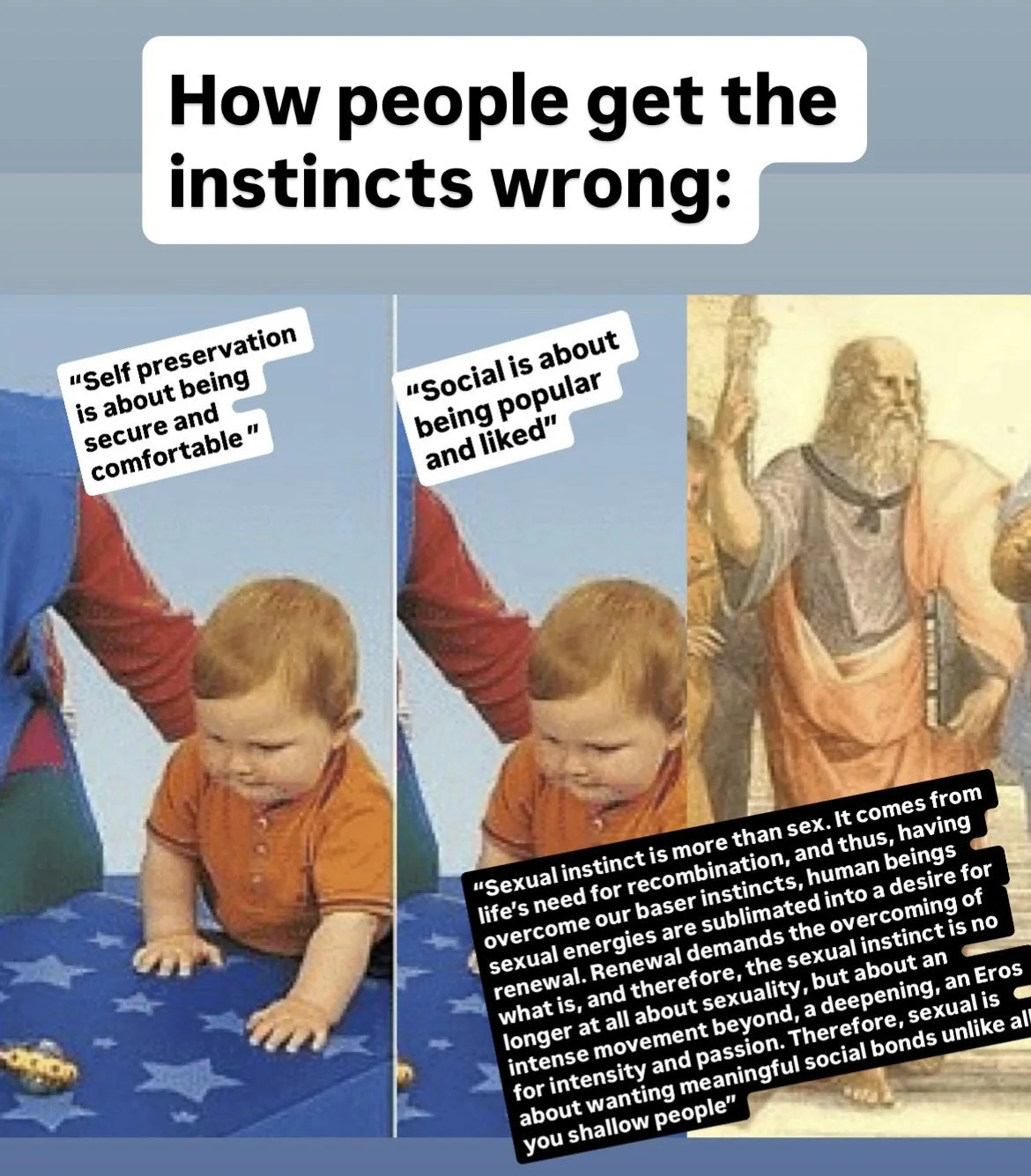
Self-pres becomes “comfort and safety.”
Social becomes “liking to be groups” or wanting to be popular.
Sexual becomes intensity, depth, meaning, spark, eros, aliveness — something transfigured beyond its biological root.
There’s often an insistence that the sexual instinct becomes something “more” than attraction. And yes, all instincts do become “more” as they interface with the emotional and mental centers. But frequently the “more” extrapolated from the Sexual Drive is largely a kind of conceptual distancing from the overtly sexual root of the instinct, stretching its meaning into a kind of energetic approach or orientation to things so it no longer has to be about sexual regulation at all.
One of the most common versions of this is to say that what begins in human beings as a sexual focus comes to be sublimated and transformed into a “higher” orientation towards an intense kind of personal contact. Yet Self-Preservation and Social aren’t subject to this level of sublimation. In this frame, the sexual drive conceptually wandered away from its root in sexual regulation and is now treated as an energetic enhancement in service of social regulation. It begins to read like a way of trying to say one is more passionate, more real, more concerned with meaning than “those other phonies.”
Seeing the instincts for what they are strips some of the mystique from personality — and that is the point. The instincts and the Enneagram are useful insofar as they help us see through our self-images, not build them up with how intense or meaningful our type supposedly makes us.
When you see how much of what you call “you” is in service of basic regulation, the personality becomes less romantic and more revealing.
Below are a few key distinctions that are often not known or overlooked in discussing and trying to understand instincts and how they function:
Personality Emerges From Instinct
The instincts are not accessories to personality. Personality does not simply “have” instincts. Instead, personality emerges as a psychological mechanism for meeting instinctual needs.
As social animals, we require a sense of self, a sense of other, and a sense of who we are to others in order to secure instinctual resources amongst other social animals. The Enneagram type represents a style by which we try to fulfill those needs and maintain a coherent selfhood through the three centers.
The instincts are not side categories to layer onto or beside type. They are structurally the root of the personality.
The Instincts Are Drives for Regulation, Not Survival Strategies
The instincts are not survival strategies. Only self-preservation is directly about biological survival. When we define all three instincts as “strategies for survival,” we end up reverse-engineering explanations to justify that premise. That’s how sexual becomes “one-on-one bonding for survival,” or social becomes “group protection.”
The better way to think of them is as drives for regulation — three different orders of physical and emotional self-regulation:
Self-Preservation is a drive for regulating physical well-being and vitality. That includes comfort and safety, but also developing all kinds of capacities that fall under self-pres: Athletics, martial arts, wellness, being really into food or cooking, etc.
Sexual is a drive for sexual regulation. It is the drive to attract a desired and willing sexual partner and to pursue (and display for) one's attractions/ to put oneself ahead of sexual competition. Sexual instinct is related to the level of sexual charge, flavor, and tension. it can easily objectify self and other.
Social is a drive for interpersonal, social regulation. It is the drive to create and maintain relationships and connections. Any time you are aware of and relating to a person's sense of identity (internal or social identity) and/or interiority, it's social. It can be deep, it can be shallow, it can be one on one, it can be more than one. It can be highly personal, it can be transactional.
The Instincts are not appetites or needs themselves. They are the motivational drives to fulfill appetites. Self-pres isn’t hunger — it’s the drive to ensure food, rest, protection, capacity. Sexual isn’t the sex drive itself — it’s the drive to ensure someone you desire desires you back, and to put oneself ahead of sexual competition. Social isn’t loneliness —, it's the drive to ensure we're not lonely by being a valued, interpersonally skillful, and interesting personality.
Instinct vs. Instinctual Type
We have all three instincts. People say that, but rarely take it seriously. There is a difference between describing an instinctual drive and describing an instinctual type. An instinctual dominant is not someone who simply has more of an instinct. An Instinctual Type (someone with a dominant instinct) is the result of identifying with an instinctual drive. It is someone who has identified with a domain of regulation — who has confused satisfying that drive with being themselves.
A sexual dominant does not just enjoy sex. They organize their personality around attracting, desiring, competing, displaying. Being desired becomes fused with being valuable.
A social dominant does not just value connection. They organize their personality around being seen, attuned to, positioned in relation. Being rightly engaged with becomes fused with being loved.
A self-pres dominant does not just care about feeling good in the body. They organize their identity around managing well-being, capacity, and lifestyle. Competence and vitality become fused with worth.
In conversations where someone is struggling to understand the sexual drive, I often point to the the prevelence of pornography, sex work, sex therapy, “sex sells” in advertising and movies, whole industries around beauty and improving ones ability to attract a mate. I’m often countered with the argument that these are indicative of sexual-blindness (in an instinctual stacking) or sex through a “self-preservation filter”. 1) Maybe and 2) it’s irrelevant. The point is that the sexual drive exerts a powerful force on human beings and has to be acknowledged, including its impact on our personality.
Moreover, within each instinct is a wide range of how each individual person expresses and feels satisfied in those instincts, regardless of stacking. Some people's Self-Preservation instinct is focused on comfort and stability. That is what feels like well-being to them. For others, it’s about working out constantly or doing stupid stunts on a mountain bike that represent vitality and strength. These are different metrics and personal sense of what 'well-being' feels like.
Some people's Social Instinct hates groups and gatherings and is about personal intimacy.
Some people's Sexual Instinct is about focusing on a specific person, and some is about having as many sexual conquests as possible.
These alone aren't indicators of type, though type/stacking can influence it.
In other words, people will often collapse the distinction of the instinctual drive itself and instinctual type, and in so doing, they intellectually dismiss claims about the influence of the sexual drive on human behavior in favor of the “more” or “sublimated sexual energy into intensity”.
The Four Levels at Stake
Instinctual resources “feed” at least four levels of need in ourselves:
Survival (primarily self-preservation)
Self-regulation
Self-esteem (how we value ourselves)
Self-image (who we take ourselves to be)
The instinct feeds not only regulation, but self-esteem and self-image. This is where the narcissistic stakes enter, and this is why there's so much at stake in instinct, even though many modern human beings aren’t in need of worry of their immediate survival, and clarify why the instincts aren't some side category to add to the enneagram, they're intrinsic to personality structure.
The instincts reveal that much of what we call personality is a structure built around securing regulation and protecting an image of ourselves as adequate, desirable, included, capable. Our main personality features are things we’ve developed (skills, traits, patterns) in service of meeting our instinctual needs.
There’s a bit of all of these in everyone, but roughly:
Self-Preservation Dominants become especially identified with how they evaluate my well-being and the means by which they shape and sustain my lifestyle. Typically emphasis on certain skills.
Sexual Dominants become especially identified with their “courtship display,” the means by which they foster attraction and elicit sexual tension and chemistry.
Social Dominants become especially identified with the means by which they are able to engage with or stay in relation to others.
The “More-Than-Sexual” Problem
Much of the confusion around the sexual instinct comes from treating it as an outlook that applies to everything. Someone claims they are sexual dominant, and that this means they bring intensity or depth to all things — including relationships that are not sexual at all.
But if we are not attempting to regulate sexual attraction, then we are not operating from the sexual drive. However, each instinct regulates through a different kind of attention, focus, excitation, and boundary. I’ve attempted to describe them in the Instinctual Approaches. They are what gives them their distinct flavor, but the flavor is in service of regulation. It doesn’t float free as “energy.”
We may be applying a sexual approach or charge to a social situation — but if the regulatory target is social attunement, the drive in play is social. And when the sexual energy/excitation of a Sexual Approach is misapplied to social regulation, it doesn’t create “more depth.” It often feels invasive, misaligned, creepy, or violating.
The instinct is defined by what need is being regulated — not by the presence of intensity. Intensity is an extremely vague term that can mean a lot of things to a lot of people.
A sexual dominant is still oriented around sexual attraction. They may confuse desirability with love. A social dominant may confuse relational engagement with love. A self-pres dominant may confuse stability and security with love. The regulatory aim remains consistent, even if they are confused with love, value, and meaning.
Everyone likes to imagine they bring a particular spark, intensity, or mystique to life. Maybe you do. But that likely has more to do with you as a person than with inflating an instinct into something it isn’t.
Misattributing the sexual instinct as “intensity applied to everything” not only distorts sexual — it also cheapens the scope and depth of the social instinct by collapsing relational attunement into something lesser. If being explicitly rooted in sexual attraction feels too base, embarrassing, or inappropriate and requires conceptual stretching to make it palatable, that may be a sign that sexual regulation is not actually central.
Grounding the instincts in regulation does not make them smaller. It makes them clearer. And clarity makes them useful.
If we are serious about the Enneagram as a tool for seeing through self-deception, then the instincts cannot remain mythologized.